Diastasis Recti and leaking: two problems with one root cause
Of the three symptom combinations I work with most frequently at re-centre, this one might be the most underestimated. Women dealing with both a tummy gap (Diastasis Recti) and bladder leaks often assume they are simply unfortunate enough to have two separate problems. What I want you to understand is that they are usually two expressions of the same underlying issue, and that changes how you approach recovering from both.
The connection between Diastasis Recti and urinary incontinence is increasingly recognised in both clinical research and postpartum rehabilitation. Studies show it is not just a coincidence that these two conditions so often arrive together, particularly after pregnancy and birth. Once you understand why, the path forward becomes a lot clearer.
Why do Diastasis Recti and bladder leaks happen together?
Your deep core works as a pressure canister, a closed system made up of the diaphragm at the top, the pelvic floor at the base, the transversus abdominis wrapping around the sides, and the multifidus at the back. When any part of that system is compromised, the others have to compensate. When multiple parts are affected at once, the whole system becomes less efficient at managing the pressure that builds up inside your abdomen during everyday movement.
What Diastasis Recti actually does to the system
Diastasis Recti is a separation of the rectus abdominis muscles at the linea alba; the connective tissue that runs down the centre of your abdomen. During pregnancy, the linea alba stretches to accommodate your growing baby, and in many women it does not fully recover its original tension afterwards.
When the linea alba loses tension, the way force is transferred through your abdominal wall changes. The core canister becomes less able to manage pressure efficiently. This means that when pressure builds inside your abdomen, from a cough, a sneeze, lifting, or impact, the system struggles to contain and redirect it. Some of that unchecked pressure goes downward, through your pelvic floor.
How this connects to bladder leaks
Stress urinary incontinence, leaking when you cough, sneeze, laugh, lift, or run, happens when the pressure that arrives at the pelvic floor exceeds what the continence mechanism can handle. A well-coordinated pelvic floor reflexively contracts to resist that pressure spike before it arrives. When the whole pressure system is less coordinated, as is often the case when the abdominal wall has separated, that reflex response is less reliable.
This shared pressure mechanism is well recognised in postnatal rehabilitation, and it is a large part of why programmes combining diastasis work with pelvic floor strengthening tend to produce better outcomes than addressing either issue in isolation.
So whilst the relationship is not simply “diastasis causes leaking”, the two are genuinely connected through shared pressure mechanics, and that is why working on both together, rather than sequentially, makes sense.
Why this is so common postnatally
Pregnancy and vaginal birth are the most significant risk factors for both conditions. Carrying a baby stretches the linea alba and loads the pelvic floor for months. Birth, particularly vaginal delivery, places significant strain on the pelvic floor muscles and connective tissue. It is not surprising that many women emerge from the postnatal period with both a gap in their abdominal wall and a pelvic floor that is struggling to manage pressure effectively. What is surprising is how rarely the two are addressed together.
How Hypopressives help when you have both
This is where I find Hypopressives most compelling for postnatal women, because they are one of the few approaches that directly addresses the pressure management problem shared by both conditions, rather than treating each symptom separately.
Training the whole system, not just the parts
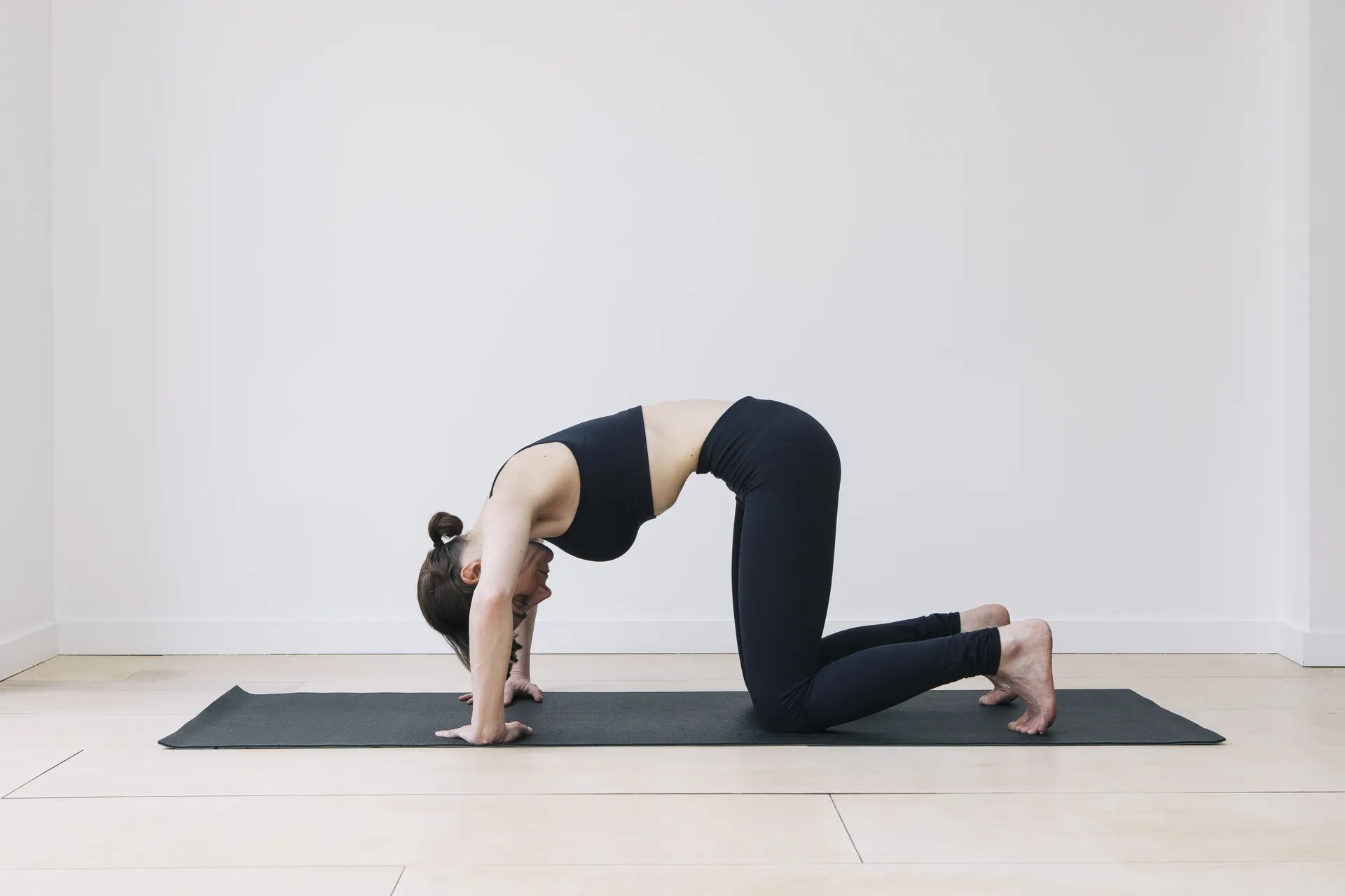
Hypopressives use specific postures combined with a breath-hold technique called an apnoea, a pause after a full exhale, without inhaling, to create a gentle vacuum effect inside the torso. This reduces intra-abdominal pressure and triggers a simultaneous reflex lift of the pelvic floor and deep core. You are training the entire pressure canister to work together more efficiently.
This is fundamentally different from conventional core exercises, which often increase intra-abdominal pressure, the very thing you are trying to manage more effectively. Crunches, sit-ups, heavy planks, and exercises that make you bear down or brace hard are all worth avoiding when both diastasis and incontinence are present, because they can reinforce the poor pressure dynamics that are driving both.
What the evidence shows for Diastasis Recti
A 6-week randomised controlled trial comparing hypopressive exercises with conventional abdominal exercises in postpartum women found that both approaches reduced the inter-rectus distance, the gap at the linea alba, to a similar degree, with multiparous women benefiting the most. Hypopressives were not shown to outperform conventional core exercise for closing the gap itself, but they offer a way to work on it without the downward pressure that crunches and sit-ups can add, which matters if incontinence is also present.
For women with incontinence alongside their diastasis, this matters enormously. You can make meaningful progress on closing the gap without the pressure loading that aggravates leaks.
What the evidence shows for incontinence
A blinded randomised controlled trial of 117 women with pelvic floor dysfunction and urinary incontinence tested an 8-week hypopressive programme and found significant improvements in pelvic floor muscle strength, incontinence severity (measured by the ICIQ-SF), symptom distress, and impact on daily life. The mechanism is the reflex pelvic floor activation triggered during the apnoea, training the system to respond to pressure changes automatically, rather than requiring a conscious squeeze every time.
Over time, this translates into practical changes: fewer leaks when you cough or laugh, better bladder control during exercise, and a pelvic floor that starts to feel more responsive in everyday life.
Combining Hypopressives with pelvic floor muscle training
Hypopressives work particularly well when combined with structured pelvic floor muscle training, Kegels done correctly, with proper technique and timing. Hypopressives provide the pressure management and reflex training; pelvic floor muscle training builds specific muscle strength and endurance. For women with both diastasis and incontinence, I typically recommend establishing the hypopressive technique first, then layering in pelvic floor muscle training once the pressure system is better coordinated.
Progressive strength training and pelvic floor-aware Pilates can be introduced later, building load gradually as both the abdominal wall and the pelvic floor become better able to manage it.
Where to begin
The most important thing is not to wait until you feel “ready”. Many women put off addressing these symptoms for months or years, assuming it is something they have to live with after having a baby. You do not.
- Start with the Getting Started with Hypopressives video in your re-centre membership. The apnoea breathing technique is the foundation of everything: learning it properly is what makes the exercises work.
- Book a live Fundamentals session with me. For women dealing with both diastasis and incontinence, I find it especially valuable to check technique in person, particularly rib and thoracic mobility, which affects how well you can create the vacuum effect.
- Three sessions of 15–20 minutes per week is the programme I recommend. That is the dose the research supports. Shorter and more consistent always beats longer and sporadic.
- Do not judge progress only by the gap. Measure it by how you feel: fewer leaks, a more stable core sensation, less urgency, better control during exercise. Those functional changes often come before the structural ones.
A note on safety: if your leaks are significant, affecting your confidence, your exercise choices, or your daily life, please see a pelvic health physiotherapist alongside starting re-centre. A physio assessment will tell you whether your pelvic floor is weak, tight, or both, and will give you a clearer picture of where to start. The two approaches work well together.
Having both Diastasis Recti and urinary incontinence does not mean your body is broken. It means your pressure system needs support and retraining, and that is exactly what I have built re-centre to provide.