Quick Answer
Your core isn’t just your abdominals. Physiotherapist Diane Lee described the deeper system, your diaphragm, deep abdominals, pelvic floor and back muscles working as one unit, as the “abdominal canister,” and real research backs the idea that these muscles are designed to coordinate, not work in isolation. Crunches flex your spine and raise abdominal pressure without that coordination, and ultrasound studies have shown abdominal curls actually pushing the pelvic floor downward rather than supporting it. Canister training, the entire principle behind Hypopressives, builds real core strength that isolated ab exercises cannot reach, though it’s worth learning the technique properly rather than guessing at it alone.
Almost every woman who comes to one of my classes has, at some point, been told that a strong core means a flat stomach and a visible six-pack. It’s one of the most persistent myths in fitness, and one of the least helpful, especially if you’re recovering from pregnancy, managing diastasis recti, or dealing with pelvic floor symptoms.
In my work teaching Hypopressives, I spend a lot of time explaining that the muscles you can see in the mirror are only a small part of your actual core. The muscles that matter most for real stability, support and pelvic floor health are mostly ones you can’t see: your diaphragm at the top, your deep abdominals wrapping around the sides, your pelvic floor at the base, and the muscles running along your spine at the back. Together, they form what’s often called your “core canister,” and training it properly looks nothing like a crunch.
What Is the Core Canister?
The idea of the core as a 360-degree canister, rather than a flat panel of abdominal muscle, comes from physiotherapist Diane Lee’s work on the lumbopelvic region. Lee and her colleagues describe the “abdominal canister” as the coordinated system of muscles and fascia, the diaphragm, transversus abdominis, pelvic floor and multifidus, that needs to work synergistically to transfer load through your spine and pelvis, manage pressure inside your abdomen, and support continence and breathing, all at the same time (Lee, Lee & McLaughlin, Journal of Bodywork and Movement Therapies, 2008).
Picture it like a soda can. The diaphragm is the top, the pelvic floor is the base, your deep abdominals (transversus abdominis) wrap around the front and sides, and your multifidus muscles run along the back of your spine. A can only holds its shape and bears weight when every wall works together. Squash one side in without the others adjusting, and the whole structure buckles. A crunch does something similar: it works the front wall hard while asking very little of the rest of the can. This is a useful way to picture how your core actually functions, but it’s a simplification, not a diagnosis, and if you have ongoing pelvic floor symptoms or suspect diastasis recti, an assessment can tell you far more than any analogy.
Why Crunches Work Against Your Canister
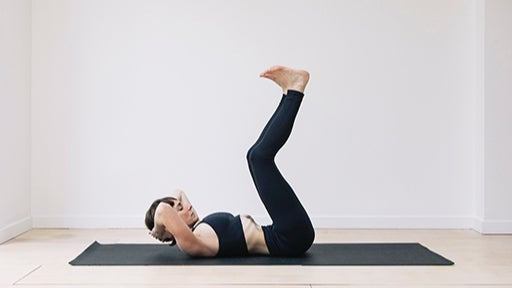
Crunches and traditional sit-ups train one part of this system almost exclusively: the rectus abdominis, the surface muscle behind the “six-pack” look, with some help from the external obliques. They do this by repeatedly flexing your spine forward while raising the pressure inside your abdomen, and that combination is exactly where the research gets interesting.
In one study, researchers measured bladder neck position during a range of abdominal and pelvic floor tasks, including a head lift, a close cousin of the crunch. Bladder neck elevation, the sign that your pelvic floor is actively lifting and supporting under load, only occurred during pelvic floor and transversus abdominis contractions. It did not occur during the head lift, even though abdominal pressure rose in much the same way (Junginger et al., International Urogynecology Journal, 2010).
A separate study used real-time ultrasound to watch what actually happens to the pelvic floor during an abdominal curl in ninety women attending regular exercise classes. Every single one of them showed the base of the bladder moving downward during the curl rather than lifting, and the effect was significantly larger in women who had given birth (Barton et al., International Urogynecology Journal, 2015). In other words, the exercise millions of people reach for as “core work” was measurably working against the pelvic floor in every single participant tested, not training it.
The Real Evidence for Coordinated Core Training
The encouraging part is that the opposite approach, the one Hypopressives is built on, has real evidence behind the coordination itself. In a now-classic study of the relationship between the abdominal wall and pelvic floor, researchers found that voluntarily contracting the pelvic floor reliably switched on the deep abdominal muscles too, particularly transversus abdominis, confirming that these muscles are designed to act as a team rather than independently (Sapsford et al., Neurourology and Urodynamics, 2001).
Separate research recording muscle activity directly from the pelvic floor during arm movements and breathing found that the pelvic floor switches on just ahead of a limb moving, as part of your body’s automatic postural bracing, and also shifts its activity in time with your breath. Your pelvic floor, in other words, isn’t a muscle you train in isolation at the end of a workout. It’s part of your postural and respiratory system every time you move or breathe (Hodges, Sapsford & Pengel, Neurourology and Urodynamics, 2007).
This is the exact system Hypopressives is designed to train. Rather than flexing the spine and bearing down, the technique combines a specific posture, a full exhale, and a held abdominal vacuum that recruits the diaphragm, transversus abdominis and pelvic floor together, with your deep back muscles providing the postural support to hold the position. A 2025 systematic review of thirteen randomised controlled trials found real, measurable benefits across exactly this system: improvements to pelvic floor function, posture and core strength (Hernandez-Lucas et al., Healthcare, 2025). In my own classes, the change clients notice first is rarely their waistline. More often it’s that their back feels more supported standing up from a low chair, or that a cough or a sneeze doesn’t catch them off guard the way it used to.
Training Your Canister Instead of Crunching
You don’t need to swear off every abdominal exercise you’ve ever done to benefit from this. A few shifts in how you approach core training make the biggest difference:
- Lead with your breath, not your spine. Before engaging your abdominals, notice whether you’re holding your breath or bearing down. Both reduce the coordination this system relies on.
- Think “lift and narrow” rather than “crunch and brace.” Drawing your pelvic floor and deep abdominals gently upward and inward recruits the canister far more directly than curling your ribs toward your hips.
- Build postural strength through your back, not just your front. Multifidus and the other deep spinal muscles are half of this system, and exercises that challenge your posture, including the standing and kneeling positions used in Hypopressives, train them directly.
- Learn the technique with proper guidance first. Hypopressives relies on a specific breath-hold and posture sequence that’s genuinely difficult to self-teach accurately from a video alone, which is why I run live Fundamentals sessions before anyone starts the full classes.
When to Seek Assessment
This guide is educational and cannot diagnose your individual core or pelvic floor function. See a GP or pelvic health physiotherapist before starting any new core training programme, including Hypopressives, if you have a visible abdominal gap or doming, ongoing leakage, pelvic heaviness or pressure, or back pain that doesn’t settle with rest. An assessment can tell you far more about what your particular canister needs than any general guide, mine included.
If diastasis recti is part of why you’re reconsidering crunches, my guide to diastasis recti exercises using Hypopressives goes into more specific technique. And if you’d like to learn the full canister-training approach properly from the start, you’re welcome to start a free 14-day trial and join one of my live Fundamentals sessions.
Sources
- Lee DG, Lee LJ, McLaughlin L. Stability, Continence and Breathing: The Role of Fascia Following Pregnancy and Delivery. Journal of Bodywork and Movement Therapies, 2008.
- Sapsford RR, Hodges PW, Richardson CA, Cooper DH, Markwell SJ, Jull GA. Co-Activation of the Abdominal and Pelvic Floor Muscles During Voluntary Exercises. Neurourology and Urodynamics, 2001.
- Hodges PW, Sapsford R, Pengel LH. Postural and Respiratory Functions of the Pelvic Floor Muscles. Neurourology and Urodynamics, 2007.
- Junginger B, Baessler K, Sapsford R, Hodges PW. Effect of Abdominal and Pelvic Floor Tasks on Muscle Activity, Abdominal Pressure and Bladder Neck. International Urogynecology Journal, 2010.
- Barton A, Serrao C, Thompson J, Briffa K. Transabdominal Ultrasound to Assess Pelvic Floor Muscle Performance During Abdominal Curl in Exercising Women. International Urogynecology Journal, 2015.
- Hernandez-Lucas P, Escobio-Prieto I, Moro López-Menchero P. Effects of Hypopressive Techniques on the CORE Complex: A Systematic Review. Healthcare, 2025.