Quick Answer
Leaking when you cough, laugh, lift or run is called stress incontinence, and it is very treatable. Hypopressives is the approach I teach for it: rather than squeezing, you use posture and a specific rib-breathing pattern so the pelvic floor lifts reflexively as part of the whole pressure system. A randomised controlled trial found reduced urinary incontinence severity and improved pelvic floor contractility after eight weeks. Common does not mean permanent, and it does not mean managing it with pads forever.
Leaking is the symptom women apologise for most and mention last. It gets filed under things that happen after babies, or after fifty, and quietly worked around with darker leggings and a spare pair of knickers. I would rather you knew it is one of the most treatable pelvic floor problems there is.
Which kind of leaking is it?
The NHS distinguishes between two main patterns, and the difference matters.
Stress incontinence is leaking on effort. A cough, a sneeze, a jump, lifting a toddler. The pressure travelling down exceeds what your pelvic floor can hold back in that moment.
Urge incontinence is the sudden desperate need to go, sometimes leaking before you get there, often set off by the key in the front door or running water.
Many women have both, which is called mixed incontinence. Symptoms alone cannot confirm which you have, and understanding the difference helps you know which part of the training matters most for you.
Why “just do your pelvic floor exercises” has not fixed it
If you have been squeezing diligently for months with nothing to show for it, the problem is almost never commitment. It is usually one of three things.
The contraction is not reaching the muscle. Many women bear down very slightly instead of lifting, which adds pressure rather than resisting it.
The pelvic floor is too tight rather than too weak. An overactive pelvic floor leaks too, and it cannot contract properly because it never fully relaxes. More squeezing makes it worse. If that rings true, read about a hypertonic pelvic floor before another set.
The timing is off, not the strength. The muscle may be strong enough but too slow to meet a cough.
All three are about how the pelvic floor works within a system, not how hard you can squeeze it. That is the gap Hypopressives is built to close.
How Hypopressives reduces leaking
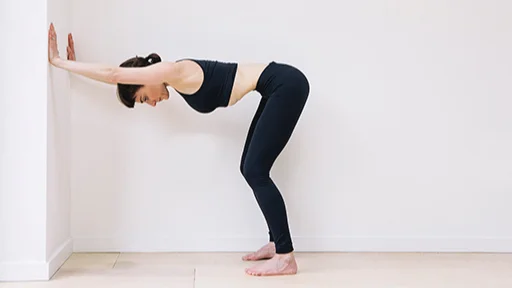
In a Hypopressive you take up a tall, precise posture, breathe laterally into your ribs, exhale completely, then open the rib cage without breathing in. The pressure inside your abdomen drops, and the pelvic floor and deep abdominal muscles respond by lifting without you consciously squeezing anything.
Two things make that useful if you leak. The lift is reflexive, so it trains the automatic response you actually need when you sneeze rather than a voluntary squeeze you have to remember. And because it works through the diaphragm and posture, it addresses the pressure management side of the problem rather than just muscle strength.
A randomised controlled trial in Neurourology and Urodynamics found that after eight weeks of Hypopressive training, women had improved pelvic floor muscle contractility and reduced severity of urinary incontinence symptoms. A systematic review in Healthcare found positive effects across the pelvic floor, transverse abdominis and diaphragm.
In my experience teaching Hypopressives, the women who arrive most discouraged, having done everything they were told for years, are frequently the ones whose leaking improves most once the breath is leading rather than the squeeze. I have seen dramatic improvement in incontinence in women who had completely given up on the idea.
everything you were told?
What a week of practice looks like
Hypopressives is a technique before it is a workout, so the first few weeks are about learning the positions and the breath rather than chasing repetitions.
- Start with short, frequent sessions. Ten to fifteen minutes, three times a week, beats one long session.
- Practise on an empty stomach. First thing in the morning, or a couple of hours after eating. The rib opening is far easier and more comfortable.
- Get the posture before the breath-hold. Alignment is what makes the technique work; the apnoea on its own does very little.
- Learn it with someone watching, at least at first. It is a technical skill and it is genuinely hard to self-correct from a video.
The Knack: the quick win while you learn
Before you cough, sneeze or lift, deliberately squeeze and lift your pelvic floor and hold through the effort. This is known as the Knack, and it is the fastest practical win available, because it protects you in the exact moment leaking would otherwise happen.
It is not a substitute for training. It is what carries you through the next six weeks while the training does its slower work.
Where the clinical guidance sits
For completeness, NICE recommends supervised pelvic floor muscle training of at least three months as first-line treatment for stress or mixed urinary incontinence, at a dose of at least eight contractions three times a day. A Cochrane review concluded that we can be confident this training can cure or improve symptoms across all types of urinary incontinence.
Pelvic floor training works. The question this page is answering is what to do when the squeezing version of it has not worked for you, and that is where a breath-led approach earns its place.
What else changes the picture
- Constipation. Straining puts repeated downward load on the pelvic floor and quietly undoes training.
- Fluid. Cutting back concentrates urine and irritates the bladder, which usually makes urgency worse, not better.
- Caffeine. Worth testing by reducing it for two weeks to see whether urgency settles.
- Weight. NICE advises that women with urinary incontinence and a BMI over 30 are supported to lose weight, because abdominal load is part of the pressure equation.
What to track before your appointment
A week of notes turns a vague appointment into a productive one:
- How often you leak, and exactly what you were doing each time
- Whether you get any warning, or none
- How much you drink and how often you go
- Whether you also feel heaviness or dragging
- What you have tried, and for how long
Useful things to say out loud:
- “Can you check I am contracting the right muscles?”
- “Is this stress, urge, or both?”
- “Could my pelvic floor be too tight rather than too weak?”
When to Seek Assessment
This guide is educational and cannot diagnose the cause of your symptoms. Arrange an assessment with a GP or pelvic health physiotherapist if leaking is affecting daily life, if you feel heaviness or a bulge, if you have pain, or if three months of consistent training has changed nothing. Seek prompt medical advice for blood in your urine, pain or burning when passing urine, sudden changes in bladder control, or difficulty passing urine at all.
around the nearest loo.
Sources
- Molina-Torres G et al. The effects of an 8-week hypopressive exercise training program on urinary incontinence and pelvic floor muscle activation: a randomized controlled trial. Neurourology and Urodynamics, 2023
- Hernandez-Lucas P, Escobio-Prieto I, Moro Lopez-Menchero P. Effects of Hypopressive Techniques on the CORE Complex: A Systematic Review. Healthcare, 2025
- NICE guideline NG123: Urinary incontinence and pelvic organ prolapse in women: management
- NHS: Urinary incontinence
- Dumoulin C, Cacciari LP, Hay-Smith EJC. Pelvic floor muscle training versus no treatment, or inactive control treatments, for urinary incontinence in women. Cochrane Database of Systematic Reviews, 2018