Women who come to me with a prolapsed uterus often describe the same thing first: a heaviness low in the pelvis, a dragging sensation that gets worse as the day goes on, a feeling that something is going to fall out, and a very real fear that moving their body will make everything worse. That fear is understandable. And it is also, in most cases, the thing that holds recovery back the most.
What I see repeatedly in my work is that many women stop exercising altogether when they receive a prolapse diagnosis. They have been told to rest, to be careful, to avoid anything strenuous, and so they do. The problem is that de-conditioning the body, weakening the surrounding musculature, and losing connection to the pelvic floor does not help prolapse. It makes it harder to manage.
A prolapsed uterus, or uterine prolapse, is what happens when the pelvic floor muscles and supporting ligaments become too weak to hold the uterus in its correct position, and it descends into the vaginal canal. More than 50% of women experience some degree of this condition, and the likelihood increases with age, multiple pregnancies, vaginal delivery, chronic straining, persistent coughing, heavy lifting, and the drop in oestrogen that comes with menopause. Some women have no symptoms at all in the early stages. Others feel pressure, a bulge, or a sensation that something is falling out.
What I want you to take from this page is straightforward: exercise, done the right way, is one of the most effective tools available for managing prolapse. Not all exercise, and not without understanding what your pelvic floor actually needs. But the right movement, with the right pressure management, can reduce symptoms, prevent progression, and give you your confidence back.
Why Exercise Matters
Pelvic floor muscle training can help alleviate symptoms when you are dealing with a prolapsed uterus, according to research. When done correctly, exercise can reduce symptoms and prevent the condition from worsening.
1. The Role of Pelvic Floor Support Muscles
The advice most women receive when they are diagnosed with prolapse is some version of “do your Kegels.” I understand why that advice exists, and I am not here to dismiss pelvic floor contractions entirely. But I am here to tell you that Kegels alone are insufficient, and in some cases they can actively make things worse.
Here is what the “just do your Kegels” advice misses. A Kegel is a voluntary contraction of the pelvic floor muscles. If those muscles are already weak and underactive, targeted contractions have a role to play. But a significant number of women presenting with prolapse symptoms are not dealing with a weak pelvic floor in the traditional sense. They are dealing with a hypertonic pelvic floor, meaning a pelvic floor that is too tight, too guarded, and unable to fully relax. Contracting an already overworked, shortened muscle does not strengthen it. It compounds the problem.
Even where Kegels are appropriate, they address only one part of a much larger system. The pelvic floor does not work in isolation. It functions as part of a pressure management system that includes the diaphragm, the deep abdominals, and the multifidus (a back muscle). Strengthening the pelvic floor through contraction alone, without addressing how pressure moves through the whole system, is like reinforcing one wall of a building while ignoring the foundations. This is precisely why pressure management, through techniques like Hypopressives, matters as much as muscle contraction, and in many cases more.
2. How Pressure Management (Like Hypopressives) Can Help
Not all exercises focus on tightening muscles. Some techniques, such as hypopressives, are designed to manage pressure inside the abdomen.
Hypopressive exercises use controlled breathing and specific postures to create a vacuum effect in the abdomen. This vacuum lifts your organs upward and away from the pelvic floor, helping them to rehabilitate in their natural position.
These exercises do not involve straining or pushing. Instead, they train your body without adding extra pressure. A consistent workout routine can improve your posture, build muscle tone, and support your pelvic floor better, especially during or after menopause.
3. Strengthening vs. Overloading
When doing exercises for a prolapsed uterus, it is essential to know the difference between supporting your pelvic floor and hurting it. Some exercises strengthen your muscles without causing stress. But there are some that push too hard and may make things worse.
Strengthening means building muscle the right way through, supportive movement techniques, like hypopressives. Overloading, on the other hand, occurs when you engage in high-impact or heavy-pressure activities, like running or doing crunches. These moves press down onto your pelvic floor, which can aggravate a prolapsed uterus.
Best Exercises for Prolapsed Uterus
If you have a mild prolapse, certain exercises can help you feel better and stay strong. Here are the most helpful types:
1. Hypopressives
Hypopressives utilize various postures and deep breathing techniques to strengthen your pelvic floor and core. Unlike crunches or sit-ups, these moves do not put pressure down into your pelvis. Instead, they create a lifting effect from the inside.
Here’s how hypopressives are helpful:
- Activating the pelvic floor muscles gently.
- Helps to reposition the organs to sit higher.
- Helping you stand taller and move better by improving your posture.
- Promoting better breathing, which transports sufficient oxygen to your muscles.
- Strengthens the connective tissue giving more support to the pelvic area.
2. Postural Training
Your posture affects your pelvic floor more than you might think. Your core muscles are at their best state when your spine and pelvis are aligned properly. The alignment also means better support for your uterus and less strain below.
Focus on your breath pattern, instead of breathing into your abdomen, focus on Diaphragmatic Breathing.
- Diaphragmatic Breathing: It involves breathing deeply into your rib cage. Doing so helps your diaphragm move freely, which has a positive effect on your pelvic floor. We want the diaphragm and the pelvic floor to work in a coordinated way for pelvic health and hypopressivesget this to happen.
3. Bridge Pose with Pelvic Floor Awareness
Bridge pose is a simple, safe way to strengthen your lower body and engage your pelvic floor at the same time.
Follow these steps to do the pose properly:
- Lie on your back with your knees bent and feet flat on the floor.
- Press your feet down and lift your hips toward the ceiling.
- As you lift, connect your pelvic floor, lower abdominals and glute muscles.
- Hold for a few seconds, then roll back down through your spine.
4. Yoga for Prolapsed Uterus
Yoga comes up often in my conversations with women managing prolapse, and the question is usually some version of: “Is it safe?” The honest answer is that it depends entirely on which poses you are doing and how you are breathing through them.
There are yoga poses that are genuinely supportive for a prolapsed uterus. Legs Up the Wall (Viparita Karani) is one of the most useful; it reverses the effect of gravity on the pelvic organs and gives the pelvic floor a genuine rest. Supported Child’s Pose encourages a gentle lengthening of the pelvic floor rather than compression. Reclined Bound Angle (Supta Baddha Konasana) opens the hips without loading the pelvic floor. Gentle Cat-Cow, done with good breath awareness, helps restore mobility to the spine and pelvis without increasing downward pressure. What these poses share is that they decompress the pelvis and work with gravity rather than against the pelvic floor.
The poses to be cautious of in a yoga class are those that significantly increase intra-abdominal pressure, meaning the internal pressure pushing down onto the pelvic floor. Boat pose (Navasana), full inversions where breath is held, deep unsupported squats, and any pose that causes you to bear down or brace hard through the abdomen are worth avoiding while you are building your foundation. This is not about avoiding yoga. It is about choosing the poses that support your recovery rather than undermine it. A good yoga teacher who understands pelvic health will be able to guide you through a practice that feels restorative rather than risky.
5. Other Helpful Poses: Aphrodite and Maya from Low Pressure Fitness
Low Pressure Fitness (LPF) uses slow movements and special breathing techniques to build strength without adding pressure. Two LPF poses are especially useful:
Aphrodite: Lie on your back with your knees bent and feet flexed. Keep your arms by your side, with your palms facing downwards. Take three breaths and an apnea and then push your heels into the ground and float your pelvis up reaching through the knees, taking your arms back behind you. Then, take a breath and roll back down.
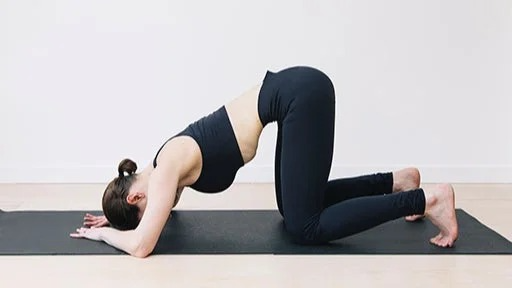
Maya: On forearms and knees, toes tucked under. Lengthen the spine and let the forehead gently find the floor. Take 3 breaths and an apnea.
Exercises to Avoid
Understanding why certain exercises are problematic is more useful than a list of things to stop doing. So let me explain the mechanism, because once you understand it, the logic becomes clear.
The pelvic floor sits at the base of the abdominal canister. Every time pressure builds inside the abdomen, that pressure has to go somewhere, and with a prolapse, it tends to go downward. High-impact activity such as running, jumping, and HIIT training generates repeated landing forces that drive pressure directly onto the pelvic floor with every stride or jump. For a pelvic floor that is already struggling to provide support, that repetitive loading is too much, too soon.
Heavy lifting carries a similar risk, particularly when it is done with a Valsalva manoeuvre, which is the instinctive breath-holding and bearing-down that most people do when they lift something heavy. That held breath dramatically spikes intra-abdominal pressure and sends a significant downward force through the pelvic floor. It is not the weight itself that is the problem; it is the pressure strategy around it.
Crunches and sit-ups work by shortening the rectus abdominis (the outermost abdominal muscle) and in doing so they compress the abdominal cavity and push pressure downward. They are one of the least appropriate exercises for anyone managing prolapse, despite being one of the most commonly recommended for “core strength.”
Deep squats load the pelvic floor at its end range of motion, at the point where it has the least mechanical advantage to resist downward pressure. Combined with any breath-holding, they become particularly problematic.
I want to be clear about something, though. These are not permanent bans for most women. They are starting-point restrictions while you build a foundation of pressure management and pelvic floor awareness. The goal of working with me is not to shrink your life or your movement. It is to give you the tools to return to full activity, with a body that can handle it.
Getting Started With Hypopressives
For the Hypopressives classes it is important that you learn the Breathing/Apnea technique properly so that you can get the most out of the classes and the time you invest in yourself. Each week I run Fundamentals sessions on Zoom where I explain the technique and guide you through all the steps. I will also give you feedback to make sure that you are doing it correctly. For some, the technique may come more quickly than others. Some of my clients, who are tighter in the ribs and thoracic spine, do tend to take a little longer. And here is the golden rule: for impactful change, I recommend at least three 15 to 20-minute workouts per week. Consistency is your best friend on this journey towards wellness.
Bladder Prolapse
Many of the women who land on this page are not only dealing with a prolapsed uterus. A significant number are also managing bladder prolapse (cystocele, where the bladder drops into the front wall of the vagina) or a combination of prolapse types affecting multiple pelvic organs. The exercises and pressure management principles covered on this page apply across prolapse types; the foundations are the same. If bladder prolapse is your primary concern, or if you are managing both, I have written a dedicated guide to safe and supportive exercises for bladder prolapse which goes into the specifics in more detail.